
Artificial intelligence (AI) is a field of computer science focused on creating computer systems and AI programs that perform tasks typically requiring human intelligence. From narrow AI systems that solve specific problems to the long-term goal of artificial general intelligence (AGI) or strong AI, AI is a powerful set of technologies reshaping industries and daily life.
History of AI
The history of AI begins with early ideas about machinery and intelligence and formal contributions in computer science and logic. Early AI research produced the first AI programs and interest in AI spurred major investments.
Periods of high expectation alternated with reduced funding, known as the AI Winter and the first AI Winter, and the second AI Winter, before modern AI saw rapid advancements.
Breakthroughs in artificial neural networks, increases in amounts of data, and improvements in hardware helped reignite AI research and lead to the advanced AI we see today.
How does AI work?
At its core, AI works by combining algorithms, data, and compute. Machine learning and deep learning are AI techniques in which AI models are trained on large datasets so that artificial neural networks and other AI algorithms learn patterns and make predictions.
Training is about finding the settings for a neural network so an artificial intelligence system can learn from examples. This means the artificial intelligence system can do things on its own after seeing some examples.
Artificial intelligence systems these days usually need a lot of data. They have to be trained many times to get better at what they do.
Understanding Traditional vs. Generative AI
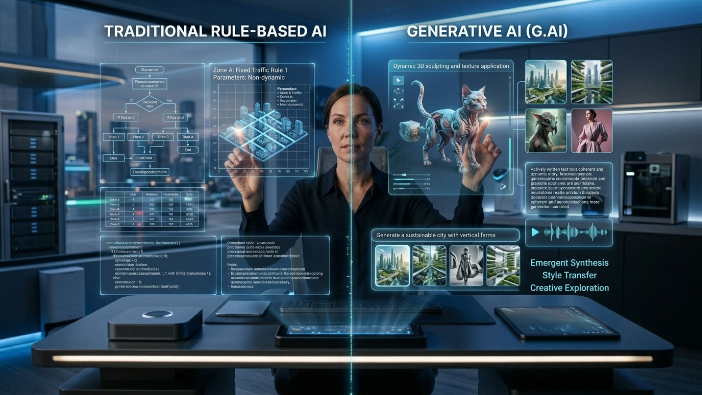
Traditional artificial intelligence usually means systems that follow rules, expert systems, and old style machine learning models that are used for jobs. Generative artificial intelligence is different; it includes artificial intelligence models and generative artificial intelligence tools that make new things like text, pictures, sound or code using methods such, as deep learning and artificial neural network architectures.
Generative AI learns to model data distributions and can produce novel outputs, powering generative AI applications and widely used generative AI tools.
Types of AI (Artificial Intelligence)
Types of artificial intelligence are often categorized by capability and function.
AICapability-based types include weak AI (narrow AI), which specializes in one task, and strongAIi or general AI (artificial general intelligence) that would match human intelligence across domains.
Functionally, AI can be reactive systems, systems with limited memory (used in many AI applications), theory of mind style projects, and future agentic systems capable of reasoning across tasks.
Artificial Intelligence and Machine Learning (ML)
AI and machine learning are really connected: machine learning is a part of AI that focuses on algorithms that help systems learn from data.
Deep learning, which is a part of machine learning, uses layers of artificial neural networks to handle complex tasks like computer vision and natural language processing.
Together, AI and machine learning power many modern AI services and AI applications.
AI Agents and Agentic AI
An AI agent is something that looks at its environment and takes actions to achieve its goals. Agentic AI refers to systems that are designed to work on their own or with the help of working with humans or other agents.
AI systems and AI agents that are capable can be used in robotics, virtual assistants and automated decision systems combining planning looking at things and learning.
AI in Action: Transforming Our World
AI is changing industries through the use of AI in things like recommendations cars that drive themselves, medical diagnostics that use computer vision and conversational systems that use natural language processing.
Real-life examples include:
- AI in healthcare
- Triage predictive
- Maintenance in manufacturing
- Finding fraud in finance
- AI applications that help with creativity and making content.
Benefits of AI
Automating Tasks That Are Repeated: AI can do time-consuming work making things more efficient and saving time.
Analyzing Data Faster: AI looks at a lot of information quickly. Finds patterns that humans might miss.
Making Better Decisions: Businesses and individuals can make informed decisions using insights and predictions from AI.
Reducing Mistakes Made By Humans: AI systems help minimize errors by doing tasks with consistency and accuracy.
Being Available All The Time: AI tools and virtual assistants can work all the time without taking breaks.
Increasing Productivity: AI allows people to focus on creative work instead of manual tasks.
Making The Customer Experience Better: powered chatbots and recommendation systems provide faster and more personalized support.
How Can AI Benefit Humanity?

AI can help with challenges by making diagnostics better optimizing energy systems and speeding up scientific discovery.
When AI is used in a way that follows ethical guidelines it can make public services better increase accessibility and help humans instead of replacing them.
Will AI Replace Jobs?
AI will change the job market some jobs might be automated. New jobs will appear. By replacing all jobs many experts think that AI will change tasks so AI handles routine tasks and humans focus on complex judgment, creativity and social skills.
Working together to teach workers skills governing AI and using AI in a thoughtful way can help make the most of the benefits while reducing disruption.
Human Resources and Recruitment
In resources and recruitment AI tools look at resumes match candidates using AI algorithms and automate administrative tasks.
AI can help reduce bias when it is designed to be fair. It also raises concerns about being transparent and the potential for perpetuating biased data, which shows the need for responsible AI and oversight such as AI regulation and AI bill of rights-style frameworks.
AI Use Cases
Artificial intelligence is not just used in research labs or technology companies anymore. Today, organizations in industries use AI to be more efficient reduce costs make customer experiences better and make better decisions.
Here are some of the practical and professional AI use cases:
1. Customer Service and Virtual Assistants
Businesses use AI-powered chatbots and virtual assistants to provide customer support answer common questions, track orders and resolve issues all the time. This reduces the time it takes to respond and makes customers happier.
Examples:
- AI chat support
- Automated customer service portals
- Virtual assistants for businesses
2. Healthcare and Medical Diagnosis
AI is transforming healthcare by helping doctors detect diseases earlier, analyze medical images, support treatment decisions, and monitor patients more effectively.
Examples:
- Medical imaging analysis
- Disease prediction systems
- Personalized treatment recommendations
3. Fraud Detection and Financial Security
Banks and financial institutions use AI to detect unusual activities, identify fraud, assess risk, and improve cybersecurity.
Examples:
- Credit card fraud detection
- Transaction monitoring
- Risk analysis systems
4. Personalized Marketing and Recommendations
AI analyzes customer behavior and preferences to create personalized experiences and increase conversions.
Examples:
- Product recommendations
- Personalized advertisements
- Customer segmentation
5. Human Resources and Recruitment
Companies use AI to streamline hiring processes and improve talent acquisition.
Examples:
- Resume screening
- Candidate matching
- Interview scheduling and evaluation
Application Development and Modernization
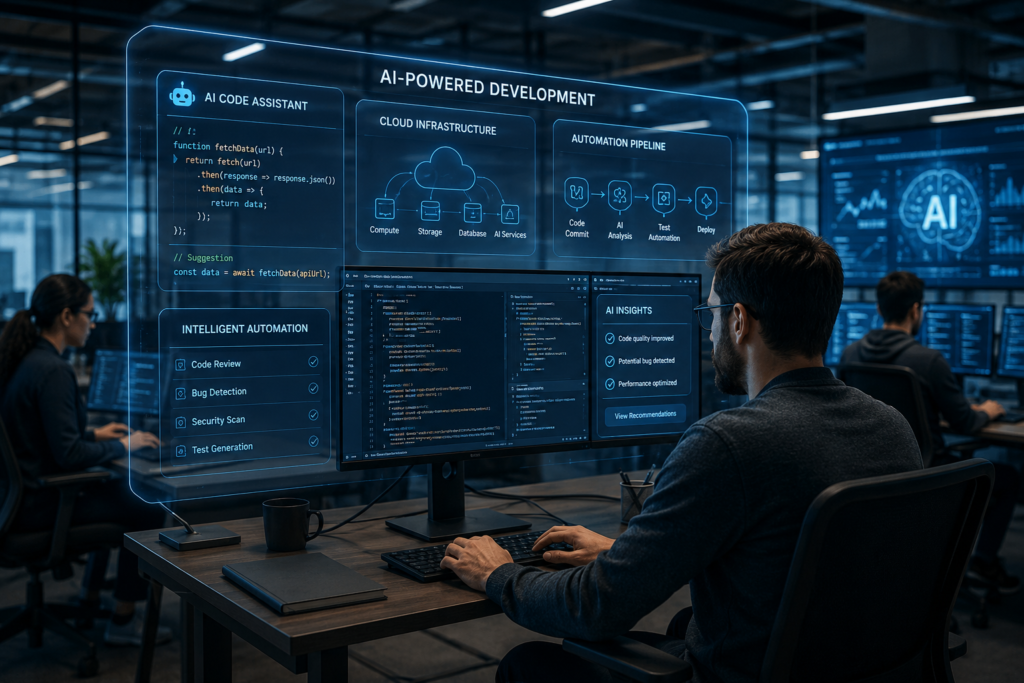
Artificial Intelligence development is about putting Artificial Intelligence models into software making systems better with Artificial Intelligence features and using Artificial Intelligence tools in the cloud and on the edges.
Developers use methods and Artificial Intelligence development practices to build strong Artificial Intelligence systems that can grow check how they are doing and keep data safe.
AI Challenges and Risks
Artificial Intelligence challenges include making sure the data is good dealing with model bias explaining how it works keeping it secure and following the rules.
The risks are things like things happening because of Artificial Intelligence decisions misusing Artificial Intelligence that can make new things and worrying about peoples privacy when using a lot of data.
To fix these problems we need Artificial Intelligence rules, laws like the EU Artificial Intelligence Act and standards from the community to make sure Artificial Intelligence is used safely and fairly.
The Future of Artificial Intelligence
The future of Artificial Intelligence will probably have Artificial Intelligence playing a role in our daily lives, with more progress in machine intelligence and better Artificial Intelligence agents.
People are still studying Artificial General Intelligence and strong Artificial Intelligence. For now the focus is on making Artificial Intelligence that we can trust that is transparent and that helps people think in a way that is similar to how the human brain works.
Conclusion / Summary
Artificial Intelligence is a field that is changing fast. It includes machine learning, deep learning, neural network models and Artificial Intelligence that can make new things.
From the beginning of Artificial Intelligence and the early days when people lost interest to the exciting things happening in Artificial Intelligence now it is clear that Artificial Intelligence is affecting many areas of life: it is changing industries creating new ways of doing things and offering many benefits of Artificial Intelligence while also posing challenges that need responsible Artificial Intelligence, rules and collaboration between Artificial Intelligence researchers, policymakers and society.
Understanding what Artificial Intelligence is and how Artificial Intelligence works will help us use the things, about Artificial Intelligence while dealing with the risks of Artificial Intelligence.