
Understanding E-commerce
An e-commerce business is any company that buys or sells goods and services over the internet. You can do e-commerce on a website or on your phone or even on media or special websites that lots of people use to buy and sell things. When you buy something online you send money over the internet. It involves the digital transfer of money and data to complete online transactions.
Nowadays e-commerce is easy because there are lots of tools to help you. You can use computer programs to build a website or use social media to sell things. E-commerce is getting bigger and bigger. In 2026 people will spend more than $6 trillion on e-commerce.
So if you have a business and you are not selling things online you might be missing out on a lot of sales.
History of E-commerce
Almost everyone has bought something online at least once, which means we’ve taken part in e-commerce. So it goes without saying that e-commerce is everywhere. But very few people may know that e-commerce has a history that predates the internet.
The start of e-commerce goes back to the 1960s, when companies used a computer system called Electronic Data Interchange to send business papers to each other.. The first real online sale did not happen until 1994, when someone bought a CD from a friend using a website called NetMarket.
E-commerce business types
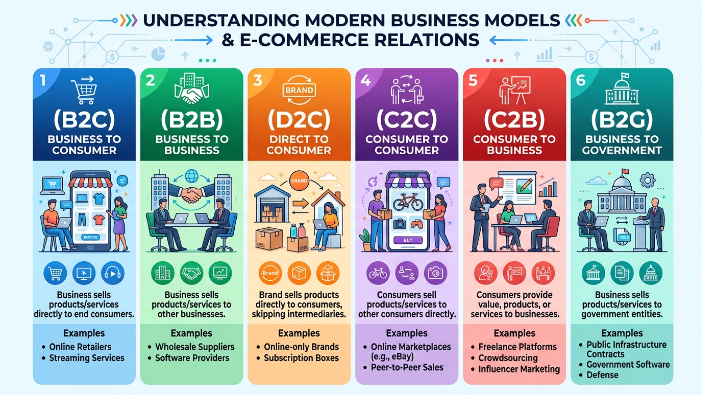
| Mo | Description | Examples |
| B2C | Businesses sell to individual consumers. | Amazon, Walmart |
| B2B | Businesses sell to other businesses. | Alibaba, SAP |
| D2C | The brand sells directly to the end customer. | Glossier, Warby Parker |
| C2C | Consumers sell to each other. | eBay, Etsy |
| C2B | Consumers sell products/services to businesses. | Fiverr, Upwork |
| B2G | Businesses sell to governments. | Government contractors |
| C2G | Consumers interact with or pay governments. | Paying taxes online |
Examples of E-commerce companies
Amazon, Ali baba, Temu, daraz
Steps to starting an e-commerce business
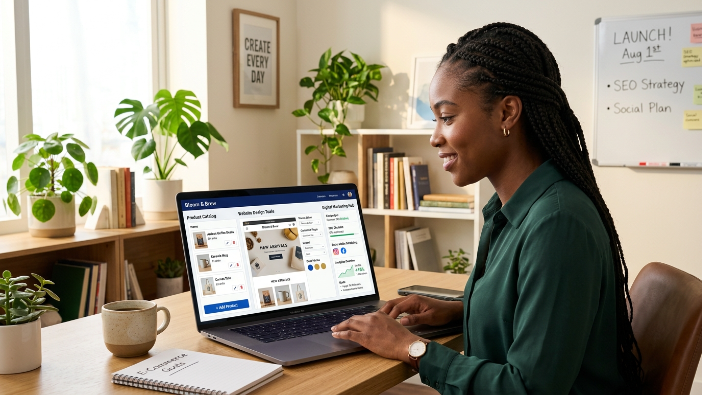
Starting an e-commerce business is like starting any business. You have to find something that people want to buy make a plan and then build a website to sell it.
- To do this you need to do a few things first. You need to look at how other businesses work, register your company, find the things you want to sell and figure out how to tell people about your business so they come and buy things from you.
- One good thing about having an e-commerce business is that it does not cost much as having a store in a building.
Pros and Cons of an E-commerce Business
Pros
- Convenience
- Increased selection
- Potentially lower start-up costs
- International sales
- Increased selection of products
- Easily retarget customers online.
Cons
Compared to a store an e-commerce business has some downsides. The main problems, with e-commerce are:
- Customer interaction: You do not get to talk to people in person or get help in a store.
- No try-before-you-buy: People can not. Test things they want to buy on the internet.
- Delayed gratification: Customers have to wait for their things to arrive.
- Technical issues: If the website crashes or the payment does not work it can hurt the business.
- Security concerns: Online stores can get hacked and lose information.
- Competition: It is easy to start an online business so there are a lot of people selling the same things, which means prices get very low.
Types of E-commerce Revenue Models
- Dropshipping
- White Labeling
- Private Labeling
- Wholesaling
- Subscription
The Future of E-commerce
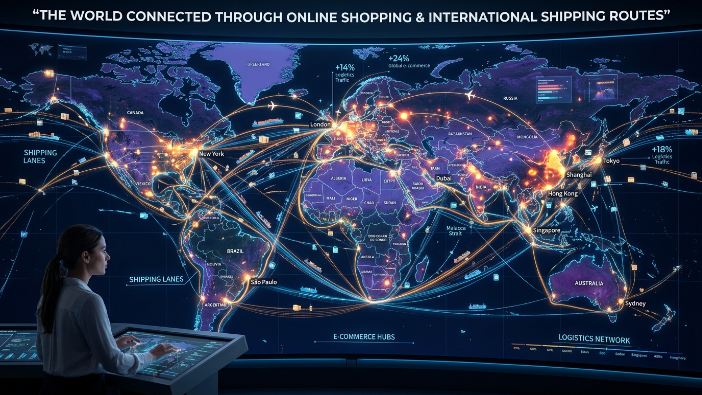
In the early days, e-commerce was mainly driven by the B2C model, with retail among the first adopters. Apart from novelty, convenience played a major role in driving demand. Multiple players entered the field, intensifying the competitive landscape. Companies started to distinguish themselves through wider product selection and more innovative services.
After retail, the service sector was the next driver of e-commerce growth. There’s a wide range of services currently offered online, including banking, insurance, travel and hospitality, education, media and entertainment, job and career sites, real estate, and brokerage services.
The Bottom Line
The retail industry has seen a transformation due to e-commerce giants such as Amazon, Alibaba, and eBay, which have compelled big traditional retailers to alter their business practices.
E-commerce has also made it easier for small businesses to discover a niche. If you’re thinking of launching an e-commerce website, be sure to conduct some market research and begin with a modest, specific emphasis so you have room to change course and expand.