
Most of us only think about our bones when something goes wrong. A wrist breaks after a small fall, a scan result comes back low, or an older relative slowly loses height. Yet your skeleton is living tissue that is rebuilt throughout your life, and the habits you keep now shape how strong it is later.
If you have been searching for how to improve bone health naturally, you have probably met a confusing mix of advice: drink more milk, avoid milk, take a calcium pill, lift heavy weights, never lift heavy weights.
I am a professional content writer, not a doctor, so I approach every health topic the same way. I read what official health bodies and published studies actually say, and I separate solid evidence from wishful thinking.
For this guide I relied mainly on fact sheets from the NIH Office of Dietary Supplements (ODS), exercise guidance from the National Institute of Arthritis and Musculoskeletal and Skin Diseases (NIAMS), and peer-reviewed research.
By the end, you will understand how bone works, which foods and nutrients matter, which kinds of exercise help, what the research does not prove, and when to talk to a healthcare professional.
The Short Answer: How to Improve Bone Health Naturally
Four habits carry most of the weight. Get enough calcium, ideally from food. Make sure you have enough vitamin D. Do regular weight-bearing and muscle-strengthening exercise. Avoid smoking and heavy drinking. Adequate protein and an overall balanced diet support all four.
“Natural” here means food, movement and lifestyle. It does not mean replacing medication or medical care. Keep that distinction in mind throughout this article.
How Bone Works, and Why Age Changes Things
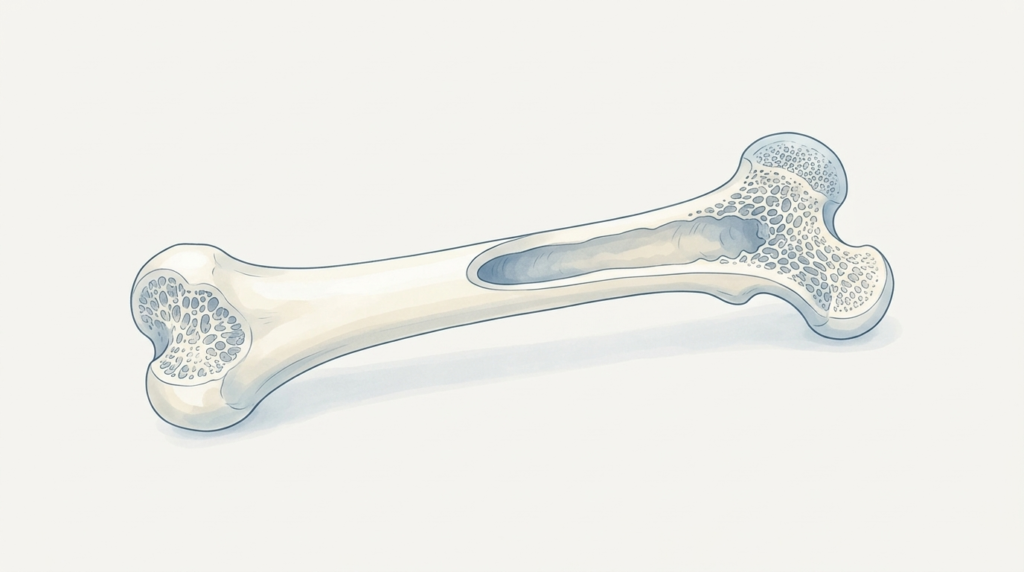
Bone is not a fixed structure. According to the ODS, almost all of the body’s calcium, about 98 percent, is stored in the skeleton, and bone is constantly being broken down and rebuilt in a process called remodelling. The body also borrows calcium from bone when it needs to keep blood levels steady.
You build bone through childhood and young adulthood, then lose it slowly with age. For women, the decline speeds up around menopause because falling oestrogen increases bone breakdown. Osteoporosis, the condition in which bones become fragile, usually causes no warning signs until a fracture happens.
Calcium: Get Enough, Preferably From Food
Calcium is the main mineral in bone. The ODS lists the Recommended Dietary Allowance (RDA) for most adults at 1,000 mg a day. It rises to 1,200 mg for women aged 51 to 70 and for everyone over 70. These are general reference values for healthy people, not personal prescriptions.
Food is the best starting point. Dairy foods are rich sources, but they are not the only ones. Canned fish with soft bones, calcium-set tofu, fortified plant milks and certain leafy greens all contribute. The ODS lists these examples:
| Food (ODS serving size) | Calcium (mg) | Practical note |
| Plain low-fat yogurt, 8 oz | 415 | Easy breakfast or snack |
| Canned sardines with bones, 3 oz | 325 | Also provides vitamin D |
| Skimmed milk, 1 cup | 299 | Lactose-free versions have similar calcium |
| Fortified soy milk, 1 cup | 299 | Check the label; fortification varies |
| Firm tofu (calcium sulfate), ½ cup | 253 | Only tofu set with calcium salts counts |
| Canned salmon with bones, 3 oz | 181 | Mash the soft bones in |
| Cooked kale, 1 cup | 94 | Good absorption, modest amount |
| Chia seeds, 1 tablespoon | 76 | Add to porridge or yogurt |
Two details matter in real life. First, absorption falls as intake rises: the ODS reports about 45 percent absorption at 200 mg a day but only 15 percent above 2,000 mg a day. Spreading calcium across meals works better than one large dose.
Second, not all plant foods deliver what their numbers suggest. Spinach contains compounds called oxalates that bind calcium, so only about 5 percent is absorbed, compared with about 27 percent from milk. Kale, broccoli and cabbage do not have this problem.
If you avoid dairy because of lactose intolerance, allergy or a vegan diet, the ODS notes you may need fortified foods or supplements to reach recommended amounts. Supplements are not automatically better.
The ODS states that absorption from supplements is highest at doses of 500 mg or less, and that very high total intakes may carry risks, including kidney stones. The evidence on calcium supplements and heart disease is mixed.
Calcium supplements can also interfere with some medicines, such as levothyroxine and certain antibiotics. Talk to a pharmacist or doctor before you start one.
Vitamin D: The Helper That Unlocks Calcium
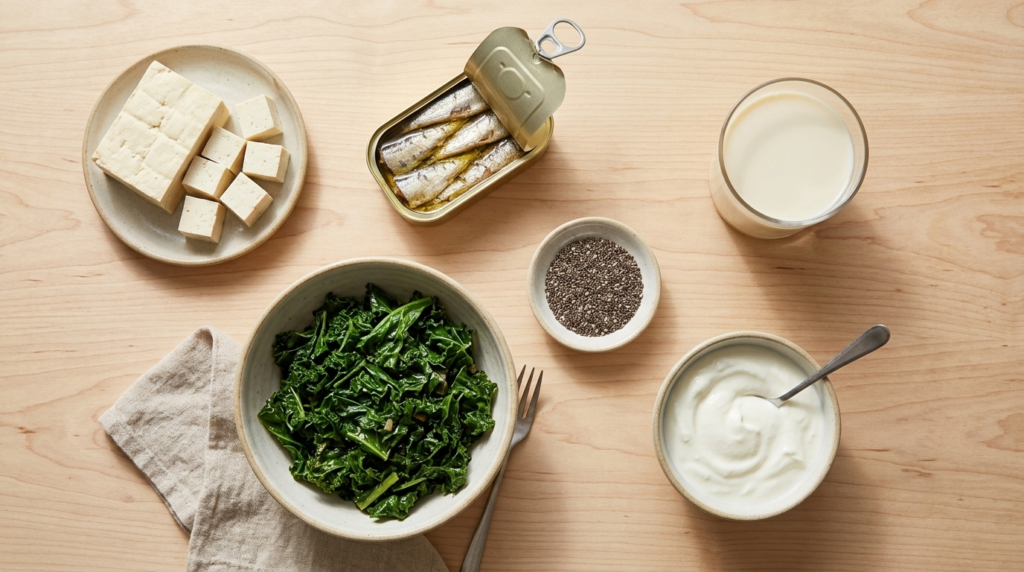
Vitamin D is required for calcium to be absorbed from the gut. Without enough of it, bones can become thin, brittle or misshapen, which in adults is called osteomalacia. The ODS gives the adult RDA as 600 IU (15 mcg) for ages 19 to 70 and 800 IU (20 mcg) for those over 70.
Very few foods contain vitamin D naturally. Oily fish, egg yolks and fortified products such as some milks, plant drinks and cereals are the main food sources. Sunlight helps your skin make vitamin D, but I would not treat it as a universal solution.
How much you make depends on your skin tone, latitude, season, clothing, sunscreen use and time outdoors, and sun exposure carries its own skin-cancer risks.
Too much vitamin D can be harmful. The ODS says high levels almost always come from supplements, not sunshine. If you suspect a deficiency, a blood test and a conversation with your doctor are safer than guessing at a dose.
Protein and the Rest of Your Plate
A 2017 systematic review and meta-analysis in the Journal of the American College of Nutrition found that protein intakes at or above the current RDA may help prevent hip fractures and bone loss. The authors also stressed that larger, longer trials are needed.
Caffeine and phosphorus reduce calcium absorption only slightly, according to the ODS, and low vitamin D status reduces it more. Mayo Clinic patient guidance also lists tobacco and excessive alcohol or caffeine as factors that can reduce bone formation. Quitting smoking and keeping alcohol moderate are real, practical steps for your bones.
Exercise: The Part Many People Underestimate
Bone responds to load. NIAMS explains that exercise helps make bone denser and replaces old bone with new bone. The most useful types are:
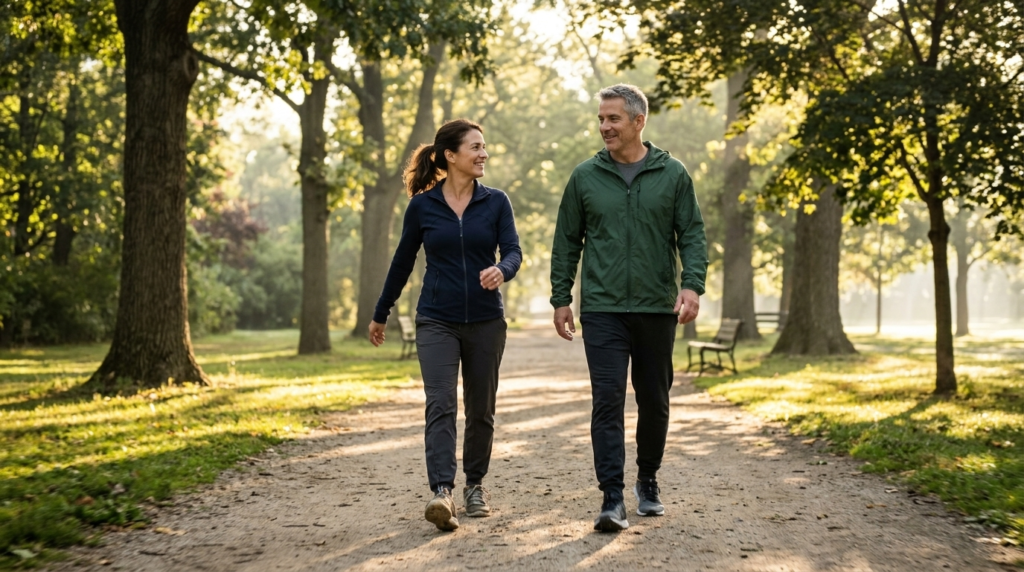
- Weight-bearing exercise, where your legs carry your body weight, such as walking, hiking, dancing and stair climbing.
- Muscle-strengthening exercise, such as resistance bands, weights or bodyweight work.
- Balance training, which reduces falls, the event that often causes fractures.
Swimming and cycling are excellent for your heart but put little load on bone.
If you already have low bone density, osteoporosis, a previous fracture, pain or mobility limits, speak to a healthcare professional before starting a new programme. Some movements, especially forceful twisting or forward bending of the spine, may not be suitable.
Six Facts About How to Improve Bone Health Naturally

- About 98 percent of your body’s calcium is stored in your bones. The skeleton is also a reserve the body draws on, so a long-term shortfall can show up in bone.
- Women lose about 1 percent of bone mineral density a year, on average, after menopause. The ODS also reports that about 30 percent of postmenopausal women in the US and Europe have osteoporosis. This is an average, not a prediction for any one person.
- Calcium absorption drops as intake rises. About 45 percent is absorbed at 200 mg a day versus 15 percent above 2,000 mg. This is why smaller amounts across the day suit your body better.
- Spinach gives you far less usable calcium than milk. Roughly 5 percent is absorbed from spinach compared with about 27 percent from milk, because of oxalates.
- Vitamin D is needed for active calcium absorption. The ODS lists RDAs of 600 IU for most adults and 800 IU above age 70.
- Adults are advised to do 150 minutes of moderate activity a week. NIAMS adds that muscle-strengthening on at least two days gives extra benefit. This is a recommendation, not a research finding about bone specifically.
Five Research Examples and What They Really Show
1. Calcium and vitamin D pills may not prevent fractures in many adults
The US Preventive Services Task Force (USPSTF) reviewed the evidence in 2018. As summarised by the ODS, it concluded with moderate certainty that daily doses below 1,000 mg of calcium and 400 IU of vitamin D do not prevent fractures in postmenopausal women, and that evidence for larger doses was inadequate.
Lesson: food-first habits and exercise matter, and pills are not a guaranteed shield.
2. A large meta-analysis found no fracture benefit from supplements
Zhao and colleagues pooled randomised trials in community-dwelling older adults (JAMA, 2017). The ODS describes the results as showing no effect of calcium alone on hip fracture, and no effect of calcium plus vitamin D on several fracture types.
Lesson: supplementation is not proven to prevent fractures in healthy older adults, which is why personal advice matters.
3. Higher calcium intake and bone density
Tai and colleagues reviewed studies of calcium intake and bone mineral density (BMJ, 2015). The ODS summarises the review as linking higher calcium intakes from diet or supplements with higher bone density in adults over 50, while noting it is unclear whether the increases are clinically meaningful.
Lesson: density numbers and fracture protection are not the same thing.
4. The LIFTMOR trial: strength training under supervision
Watson and colleagues randomised 101 postmenopausal women with low bone mass (average age 65) to eight months of twice-weekly, 30-minute supervised high-intensity resistance and impact training, or a low-intensity home programme (Journal of Bone and Mineral Research, 2018). The supervised group improved indices of bone strength and physical function, and no adverse events occurred under close supervision.
Lesson: progressive strength work can be effective, but this was a supervised, screened group, so please do not copy it alone.
Everyday Actions You Can Start This Week
Add one calcium source to each meal, such as yogurt at breakfast, sardines or tofu at lunch, and fortified plant milk in tea or cereal.
- Walk briskly for 30 minutes most days, and add stairs where you can.
- Do two short strength sessions a week with bands, weights or bodyweight moves.
- Practise balance, for example standing on one leg while holding a counter.
- Keep alcohol moderate and ask for support to stop smoking.
- Eat protein at every meal, from eggs, fish, beans, lentils or dairy.
- Do not start high-dose supplements without advice.
A Hypothetical Example
Imagine Amina, a hypothetical 45-year-old office worker who eats little dairy and sits most of the day. She switches one tea to fortified soy milk, adds canned salmon to lunch twice a week, walks 20 minutes after work, and does two short band workouts at home.
She also asks her doctor whether a vitamin D test makes sense. Nothing dramatic, which is the point: small habits are easier to keep for years.
A Simple Four-Week Starter Plan
| Week | Focus | Goal |
| 1 | Food audit | Note your calcium sources and add one per day |
| 2 | Movement | Walk 20 to 30 minutes on most days |
| 3 | Strength and balance | Add two short strength sessions and a balance drill |
| 4 | Review | Check labels, habits and questions for your doctor |
Common Mistakes and Misconceptions
- “More calcium is always better.” It is not. Absorption falls at high intakes and upper limits exist.
- “Sunshine alone covers vitamin D.” It depends on skin, season, location and sun safety.
- “Any exercise builds bone.” Load-bearing and strengthening exercise does most of the work.
When to Speak to a Healthcare Professional
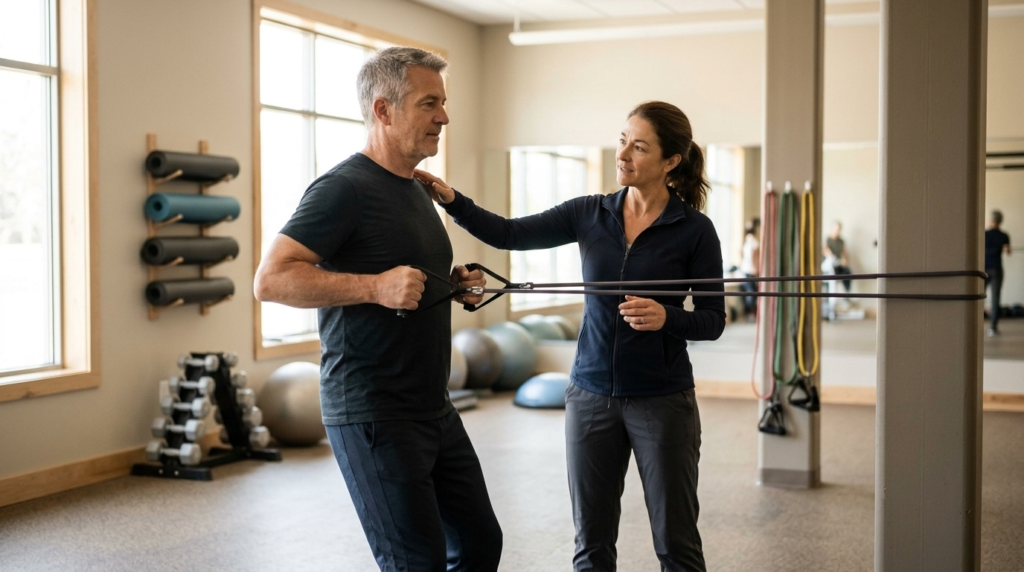
Seek advice if you have had a fracture from a minor fall, notice height loss or a curved upper back, are postmenopausal, take long-term medicines that affect bone, have a condition affecting absorption, or are considering supplements. A professional can discuss a bone density scan and suitable exercises for you.
Disclaimer
This article is educational and not individual medical advice. Nutrient needs vary with age, sex, pregnancy, health conditions and medicines. Please consult a qualified healthcare professional about symptoms, diagnoses, supplements, medication or treatment decisions, and do not stop or change prescribed treatment because of anything you have read here.
Conclusion
Learning how to improve bone health naturally comes down to a handful of realistic habits: calcium-rich foods, enough vitamin D, regular weight-bearing and strength exercise, protein at meals, and fewer bone-harming behaviours such as smoking and heavy drinking.
The research also tells us where certainty ends. Supplements have not been proven to prevent fractures in many healthy adults, and exercise programmes should suit your health.
Pick one habit from this article and start this week. Your future self will thank you.
Which of these habits will you try first, and what would make it easier to stick with? I would love to hear in the comments.
Frequently Asked Questions
1. What is the fastest way to improve bone health naturally?
There is no fast fix. Bone changes over months and years. The most reliable approach combines enough calcium and vitamin D, regular weight-bearing and strength exercise, and avoiding smoking and heavy drinking.
2. Can you rebuild bone density naturally?
Exercise and good nutrition can help maintain bone and may improve density in some people, as in the LIFTMOR trial. They cannot be promised to reverse osteoporosis, and some people need medication.
3. Which foods are best for strong bones?
Dairy foods, canned fish with bones, calcium-set tofu, fortified plant milks and some greens such as kale and bok choy provide calcium. Eggs, oily fish and fortified foods contribute vitamin D.
4. Do I need a calcium supplement?
Not necessarily. The ODS says most people can reach recommended amounts through food, and that supplements are most absorbed at 500 mg or less at a time. Ask your doctor first.
5. Is walking enough for bone health?
Walking is weight-bearing and helpful, but adding strength and balance work gives a fuller programme, particularly as you age.
6. Does coffee weaken bones?
The ODS says caffeine reduces calcium absorption only slightly. Moderate coffee is unlikely to be a big concern if your calcium and vitamin D intakes are adequate.