
Introduction to Agentic AI
Artificial intelligence is entering a new phase. For years, AI has been used to automate tasks, generate content, and support decision-making. Now, a more advanced approach is gaining attention: agentic AI.
Instead of responding to one instruction at a time, these systems are designed to work toward goals, make decisions, and adapt along the way. This shift is changing how businesses and people interact with technology.
Agentic AI is being explored across industries because it offers more than efficiency it introduces a new way for digital systems to participate in solving problems and completing work.
What Is Agentic AI?
Agentic AI refers to artificial intelligence systems that can act with a degree of independence while pursuing specific objectives. Unlike traditional AI, which waits for instructions at each step, agentic AI can evaluate situations, choose actions, and continue working toward an outcome.
These systems combine reasoning, planning, memory, and execution. For example, an AI agent managing customer support could prioritize requests, collect information, and improve responses over time.
The goal is not only to generate outputs but to achieve meaningful results through ongoing decision-making.
How Agentic AI Is Different from Traditional AI
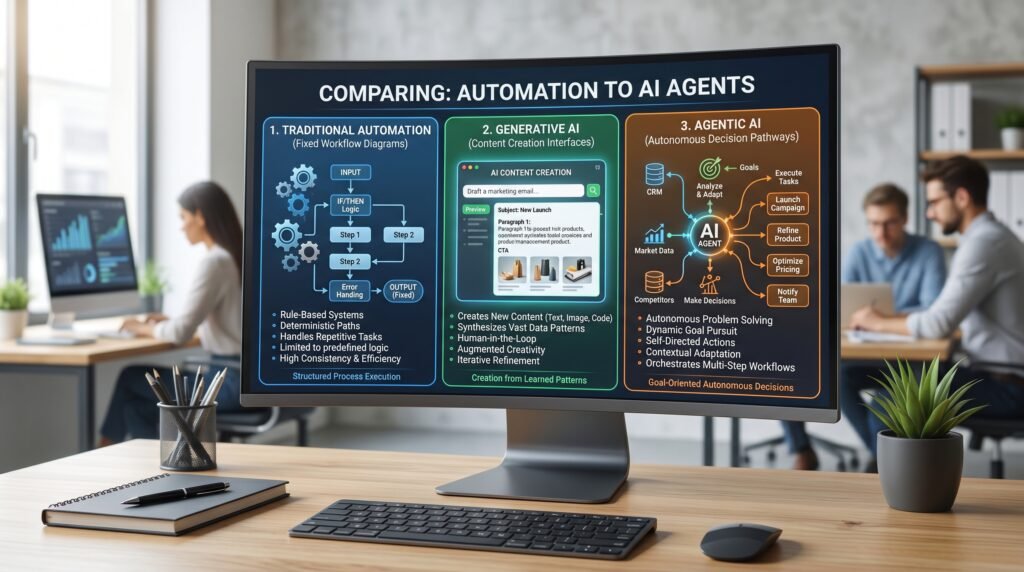
Traditional AI is usually task-based and operates within predefined rules. It performs one action at a time and often depends heavily on human direction. Agentic AI takes a more outcome-focused approach.
Rather than asking for instructions repeatedly, it receives a goal and determines how to move forward. This allows it to respond more effectively to changing conditions. The difference is not just automation it is adaptability.
Agentic AI introduces systems that can plan, adjust, and make decisions in ways that feel closer to how people approach complex work.
Core Concepts Behind Agentic AI
Several ideas define how agentic AI works. Autonomy allows systems to act with reduced human involvement. Goal orientation helps agents stay focused on outcomes instead of isolated tasks.
Planning enables AI to divide complex objectives into manageable actions. Context awareness allows the system to adjust based on new information. Together, these capabilities create AI that can move through workflows with more flexibility.
These concepts are becoming central to the development of intelligent systems across modern digital environments.
Key Characteristics of Agentic AI Systems
Agentic AI systems are recognized by several important characteristics. They can make multi-step decisions instead of reacting once and stopping. They often maintain memory across tasks, helping them improve continuity and context.
systems are designed to learn from interactions and refine performance over time. Another defining trait is action-oriented behaviour the ability to move from analysis to execution. These characteristics make agentic AI more dynamic than earlier generations of automation technologies.
Types of Agentic AI Systems

Agentic AI systems are not built in one standard format. Different types are designed to achieve different objectives, levels of autonomy, and decision-making capabilities. Some focus on responding quickly to changing conditions, while others are built to learn, plan, and collaborate across more complex environments.
1. Reactive Agents
Reactive agents respond to current inputs and conditions without relying heavily on memory or long-term planning. They make decisions based on what is happening in the moment and are often used in fast-response environments.
2. Goal-Based Agents
Goal-based agents work toward specific outcomes rather than simply reacting to events. They evaluate multiple possible actions and select the one that best supports the intended objective.
3. Learning Agents
Learning agents improve their performance over time by analyzing previous interactions and outcomes. These systems adapt through experience and become more effective as they receive feedback.
4. Multi-Agent Systems
Multi-agent systems consist of multiple AI agents working together to complete larger or more complex tasks. Each agent may handle a specific responsibility while coordinating with others to achieve shared goals.
5. Utility-Based Agents
Utility-based agents make decisions by comparing different outcomes and choosing the option that delivers the highest overall value or efficiency. These systems are useful in situations that involve trade-offs and optimization.
6. Hierarchical Agents
Hierarchical agents organize decision-making across different levels. Higher-level agents manage strategy and objectives, while lower-level agents execute individual tasks and operations.
Agentic AI vs Generative AI vs Traditional Automation
While these technologies are connected, they serve different purposes. The comparison below shows how Traditional Automation, Generative AI, and Agentic AI differ in capabilities and use cases.
| Comparison Area | Traditional Automation | Generative AI | Agentic AI |
| Main Purpose | Execute predefined tasks | Generate new content | Achieve goals through actions |
| Decision Making | Rule-based | Prompt-based | Autonomous |
| Human Involvement | High | Moderate | Lower |
| Adaptability | Low | Medium | High |
| Learning Ability | Minimal | Pattern learning | Continuous improvement |
| Output | Repetitive actions | Text, images, code | Decisions + actions |
| Workflow Style | Fixed | Flexible | Dynamic |
| Problem Solving | Basic | Moderate | Advanced |
| Multi-Step Execution | No | Limited | Yes |
| Context Awareness | Low | Medium | High |
| Planning Capability | None | Limited | Strong |
| Autonomy Level | Low | Medium | High |
| Best Use Case | Routine processes | Content creation | Complex workflows |
| Example | Payroll automation | AI writing tools | Autonomous AI agents |
Quick Summary:
Traditional Automation follows instructions, Generative AI creates outputs, and Agentic AI plans, decides, and executes tasks to reach objectives.
AI Agent Collaboration You Can Trust
One of the most promising developments in agentic AI is collaboration between intelligent agents. Rather than relying on one large system, organizations can deploy specialized agents that communicate and divide responsibilities.
One agent may gather data while another analyzes results and another executes actions. Trust becomes essential in these environments. Reliable collaboration depends on transparency, clear decision boundaries, and human oversight.
Strong governance ensures that intelligent systems remain useful, accountable, and aligned with business goals.
How Businesses Are Using Agentic AI
Businesses are adopting agentic AI to improve efficiency and reduce manual work. Customer service teams use intelligent agents to manage support requests. Operations teams apply them to streamline internal processes and improve planning. In finance, AI agents assist with monitoring and reporting.
Retail and e-commerce companies are exploring personalized customer experiences powered by autonomous systems. The value comes from reducing repetitive effort while enabling teams to focus on strategic work.
Real-World Applications of Agentic AI
Agentic AI is no longer limited to research labs or early-stage experimentation. Organizations across industries are beginning to use intelligent agents to support operations, improve efficiency, and manage increasingly complex workflows.
Rather than automating one isolated task at a time, these systems are designed to work toward outcomes and adapt as conditions change. As adoption grows, agentic AI is becoming a practical business capability rather than a future concept.
Industries Using Agentic AI
Healthcare
Healthcare organizations are exploring agentic AI to reduce administrative pressure and improve coordination across services. These systems help support operational tasks while allowing professionals to focus more time on patient care.
- Supporting scheduling and patient coordination
- Managing administrative workflows
- Assisting with operational planning
Finance
Financial institutions are using agentic AI to improve speed, consistency, and data-driven decision-making.
The focus is not replacing professionals but strengthening operational performance.
- Improving reporting and financial analysis
- Supporting fraud monitoring processes
- Automating internal operations
Manufacturing
Manufacturing environments increasingly depend on intelligent systems to improve productivity and reduce operational delays. Agentic AI helps create more responsive production environments.
- Optimizing production decisions
- Improving workflow efficiency
- Supporting predictive maintenance
Education
Education platforms are adopting agentic AI to deliver more flexible and personalized learning experiences. Intelligent systems are helping educators adapt content and support learners more effectively.
- Delivering adaptive learning experiences
- Supporting personalized education paths
- Automating academic administration
E-commerce
Digital commerce continues to be one of the fastest-growing areas for agentic AI adoption. Businesses are using intelligent systems to improve customer experiences and streamline engagement.
Personalizing customer recommendations
Improving customer engagement
Streamlining digital operations
Examples of Agentic AI in Action

The practical use of agentic AI is expanding quickly across modern workplaces. Instead of functioning only as assistants, these systems increasingly coordinate activities, complete tasks, and support ongoing decision-making.
Many current applications combine reasoning, execution, and automation to improve business outcomes. These examples show how agentic AI is becoming part of everyday operations, these systems increasingly coordinate activities, complete tasks, and support ongoing decision-making.
Many current applications combine reasoning, execution, and automation to improve business outcomes. These examples show how agentic AI is becoming part of everyday operations.
Common Examples of Agentic AI
AI Research Assistants
Research-focused AI agents help reduce time spent gathering and organizing information. Their role is to support faster analysis and more efficient knowledge discovery.
- Collect information from multiple sources
- Organize findings and generate summaries
- Support faster knowledge discovery
Customer Support Agents
Customer service teams are adopting intelligent agents to improve response quality and maintain continuity across interactions.
- Handle conversations automatically
- Manage follow-up interactions
- Improve response efficiency
Business Operations Assistants
Operations teams use agentic systems to connect processes and reduce repetitive coordination work.
- Coordinate workflows across systems
- Reduce manual process management
- Improve execution speed
Software Development Agents
Development teams are increasingly integrating intelligent agents into software delivery workflows to improve speed and consistency.
- Support testing and debugging
- Assist with workflow execution
- Accelerate development cycles
Advantages of Agentic AI
Agentic AI is attracting strong interest because it extends automation into areas that require planning, adaptation, and decision-making. Organizations see value not only in reducing manual effort but also in improving responsiveness and operational quality.
These systems create opportunities to shift human attention toward higher-value work. As adoption grows, the benefits continue to expand across industries.
Key Advantages of Agentic AI
The advantages below explain why many businesses view agentic AI as an important step in the evolution of intelligent systems.
- Increased productivity through intelligent execution
- Faster decision-making with continuous processing
- Reduced manual and repetitive work
- Improved operational efficiency
- Greater flexibility in changing environments
- Better workflow coordination across teams
- More time for strategic and creative work
- Enhanced scalability for growing organizations
Risks and Challenges of Agentic AI
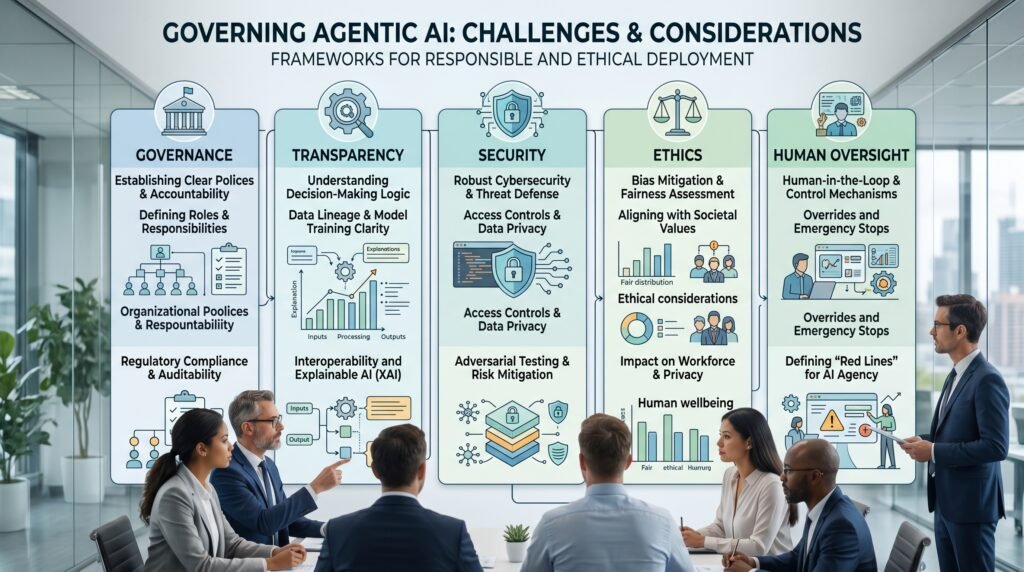
While the opportunities are significant, agentic AI also introduces new responsibilities. Greater autonomy requires stronger governance, clearer accountability, and thoughtful implementation practices.
Organizations must balance innovation with trust, reliability, and operational control. Long-term success depends on adopting these technologies with clear oversight.
Main Risks and Challenges
Governance Challenges
Strong governance becomes essential when intelligent systems begin making operational decisions independently.
- Maintaining oversight of autonomous decisions
- Defining clear accountability structures
Security Risks
As AI systems become more connected, protecting data and operations becomes increasingly important.
- Protecting systems from misuse
- Managing operational vulnerabilities
Ethical Considerations
Responsible implementation requires attention to fairness, transparency, and responsible outcomes.
- Reducing unintended bias
- Improving transparency in outcomes
Reliability Concerns
Organizations must ensure AI systems remain stable and aligned with expected goals.
- Ensuring consistent performance
- Preventing unexpected behaviour
Limitations of Agentic AI
Although agentic AI represents an important advancement, it still has practical limitations. These systems require reliable data, strong infrastructure, and clearly defined objectives to perform effectively.
Human judgment remains essential in areas that involve nuance, ethics, and complex decision-making. Understanding these limits helps organizations apply AI more responsibly and realistically.
Current Limitations of Agentic AI
The following limitations continue to influence how organizations implement and scale agentic systems.
- Dependence on high-quality data
- Limited emotional and human understanding
- Complex implementation requirements
- Higher infrastructure and integration costs
- Difficulty handling highly ambiguous situations
- Ongoing need for human supervision
- Regulatory and compliance considerations
- Challenges in measuring long-term outcomes
The Future of Agentic AI

The future of agentic AI will likely focus on greater collaboration between people and intelligent systems rather than full replacement. Organizations are exploring ways to combine human creativity with AI-driven execution.
Future systems may become more personalized, context-aware, and capable of managing increasingly complex workflows. As governance frameworks improve, agentic AI is expected to become a core part of how businesses operate and innovate.
Final Thoughts
Agentic AI represents an important shift in the evolution of artificial intelligence. Instead of simply responding to commands, these systems are designed to think through actions and work toward goals.
While challenges remain, the technology is creating new possibilities across industries. Businesses and individuals who understand this transition early will be better prepared for the next generation of intelligent digital experiences.